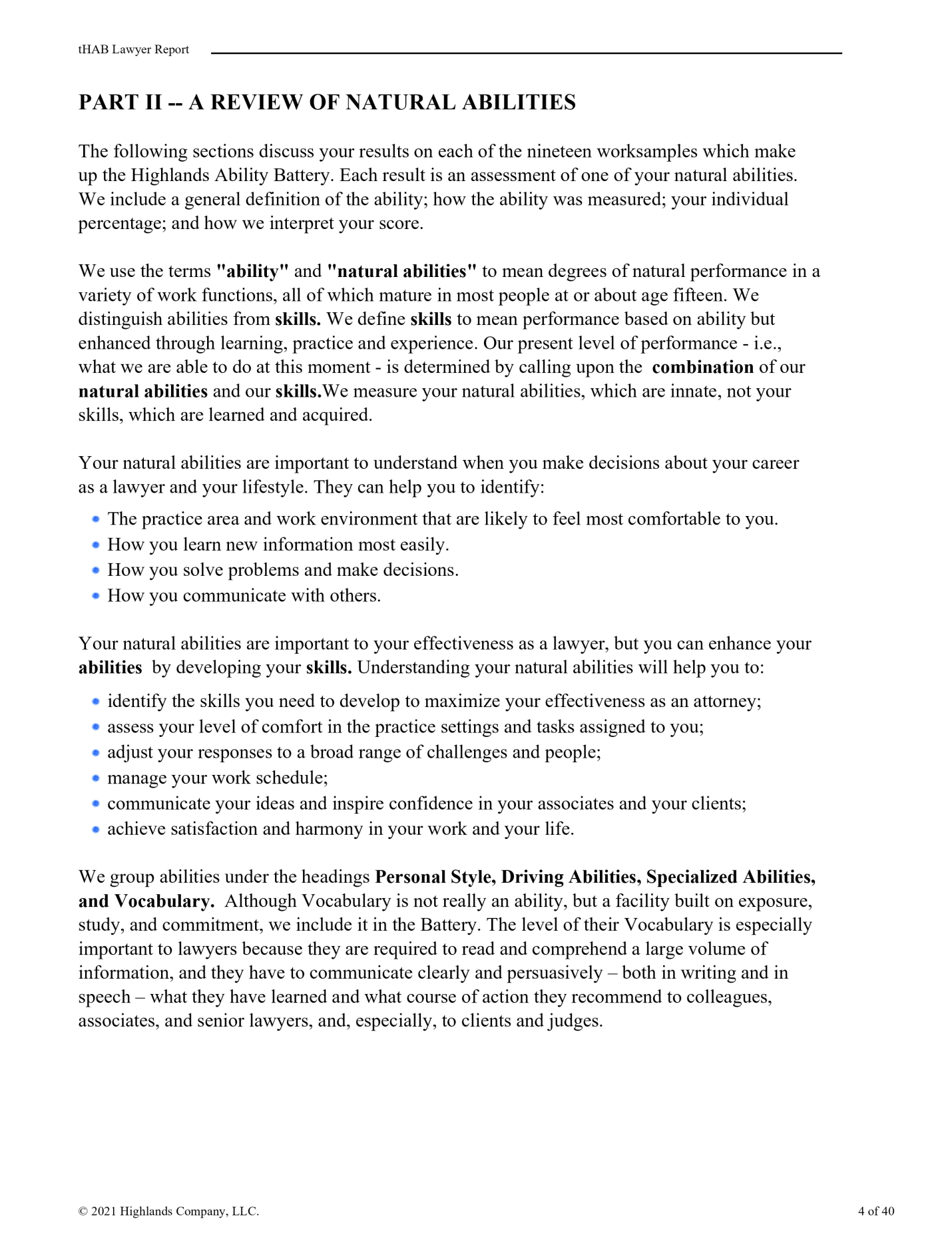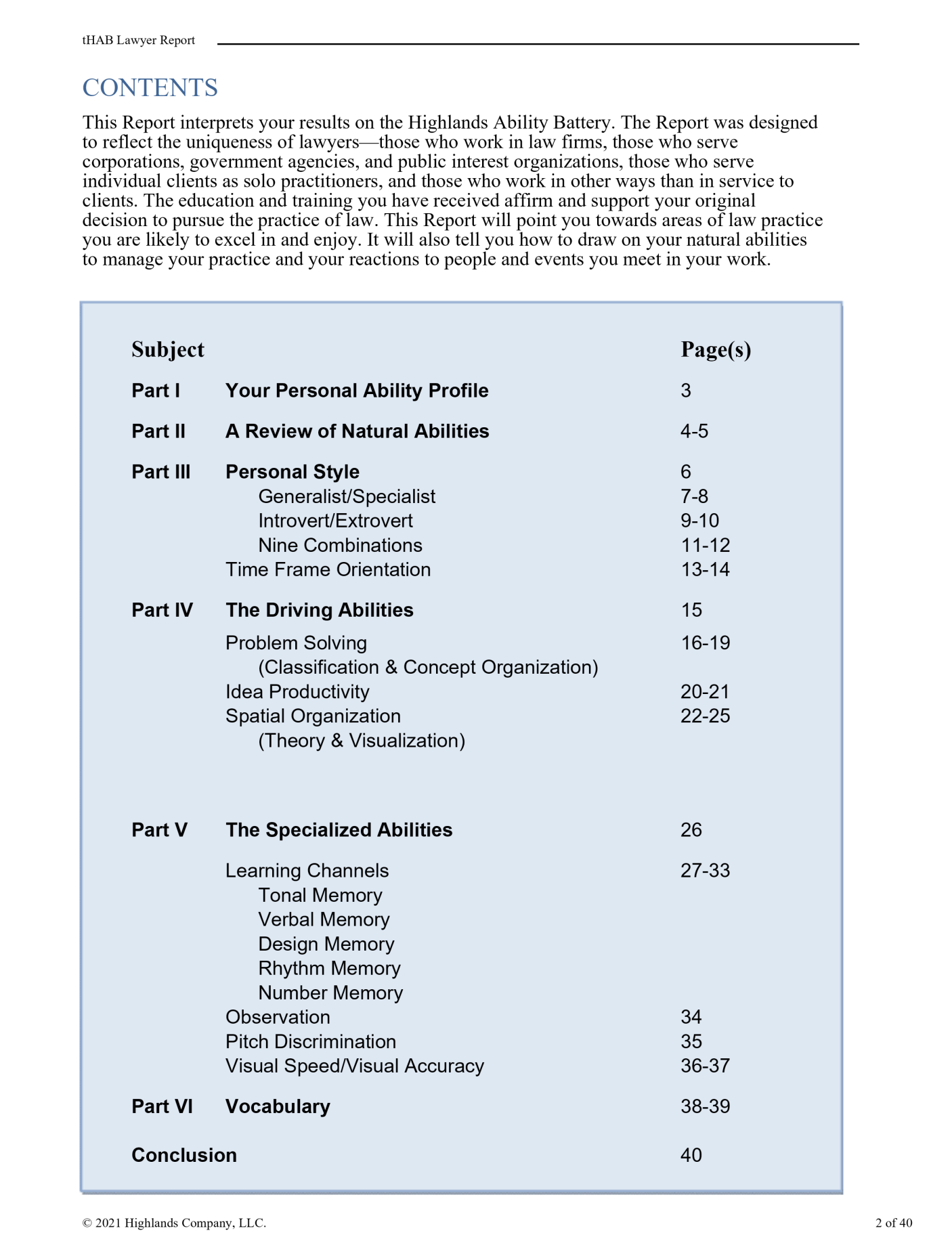
The Highlands Ability Battery (HAB) Lawyers Report helps law students, attorneys, and law firms understand the natural abilities, work styles, problem-solving approaches, and learning preferences that influence success and satisfaction in the legal profession.
By identifying how lawyers naturally think, communicate, learn, and work, the HAB supports more informed decisions about legal practice areas, career development, work assignments, hiring, and partnership potential
What Does the HAB Lawyers Report Reveal?
The HAB uses timed work samples that reflect functions lawyers regularly perform. Unlike an interest or personality test, this legal career assessment measures natural abilities that can influence an attorney's work style, productivity, and career satisfaction.
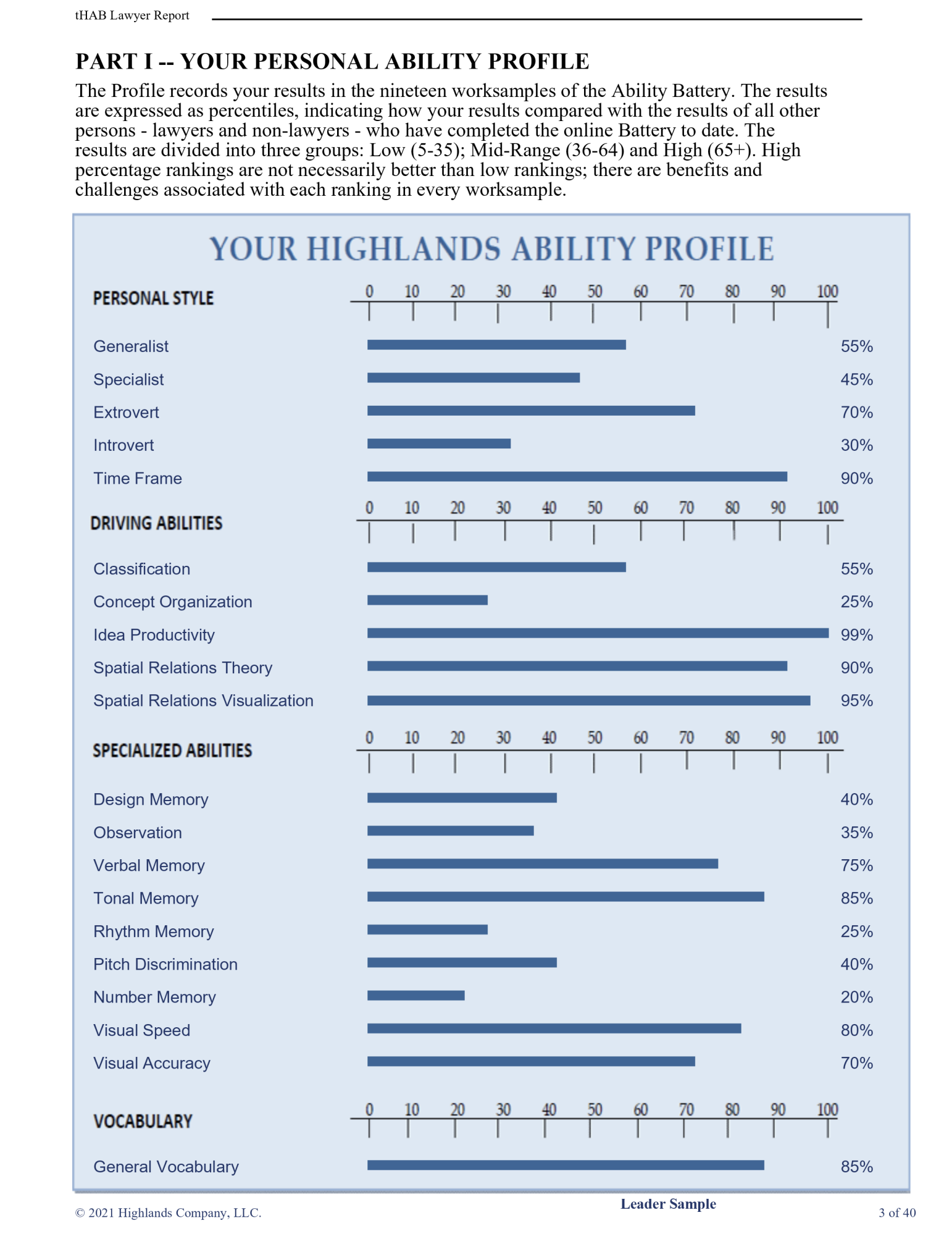
Generalist or Specialist Work Style
Many lawyers demonstrate a Specialist work style. Specialists often prefer to develop deep expertise, focus on individual projects, and become authorities in specific subject areas.
Generalists may prefer a broader range of cases, clients, responsibilities, or transactions. Understanding this distinction can help attorneys identify legal practice settings that better match how they naturally work.
Introversion, Extroversion, or Ambiversion
Lawyers may be Introverts, Extroverts, or Ambiverts who combine characteristics of both. These preferences can influence communication, client interaction, networking, collaboration, and the types of legal work an attorney finds most satisfying.
Time Perspective and Planning
Legal work requires attorneys to move between long-term strategic planning and short-term execution. Understanding an attorney's natural time orientation can help identify strengths and development opportunities related to planning, deadlines, and case management.
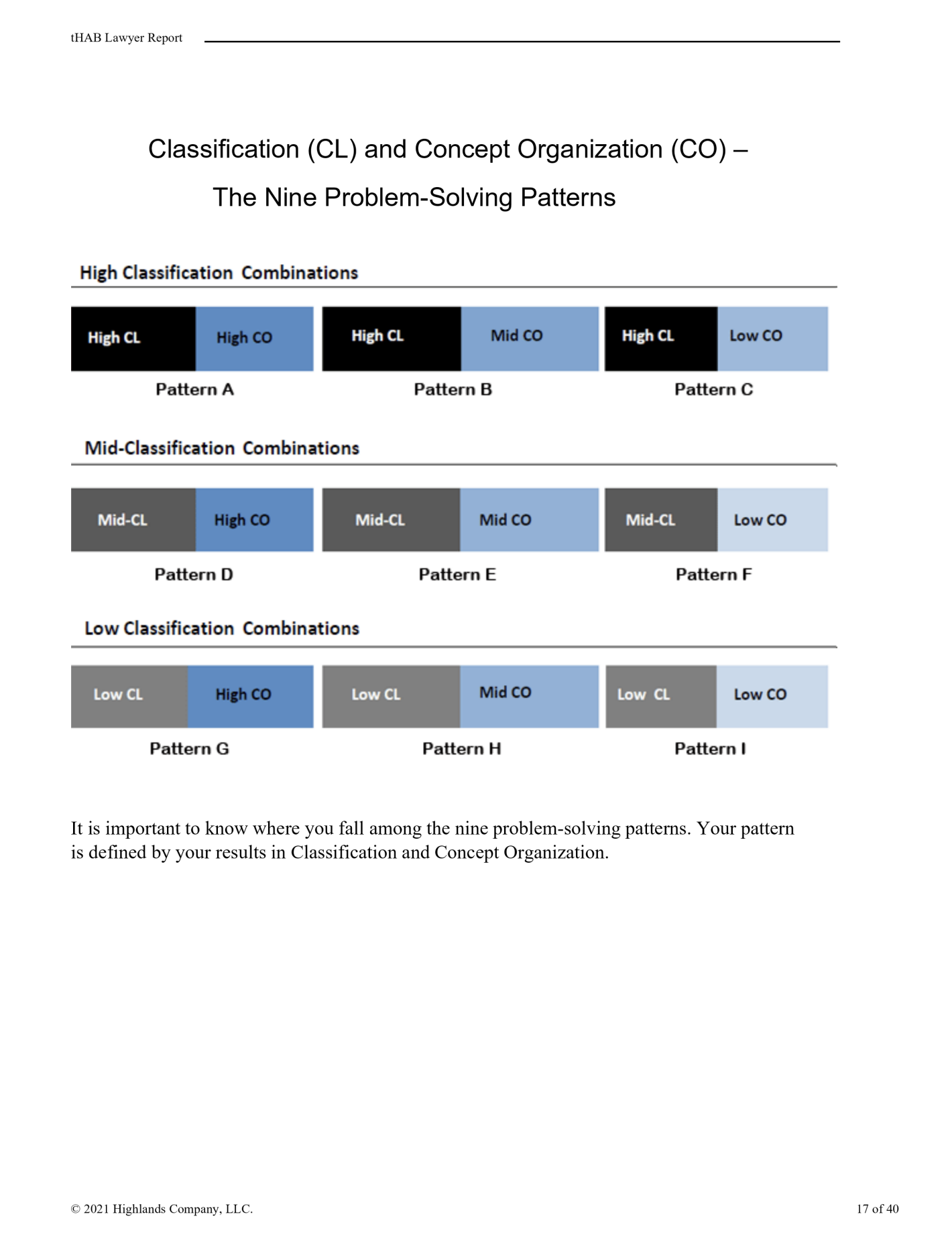
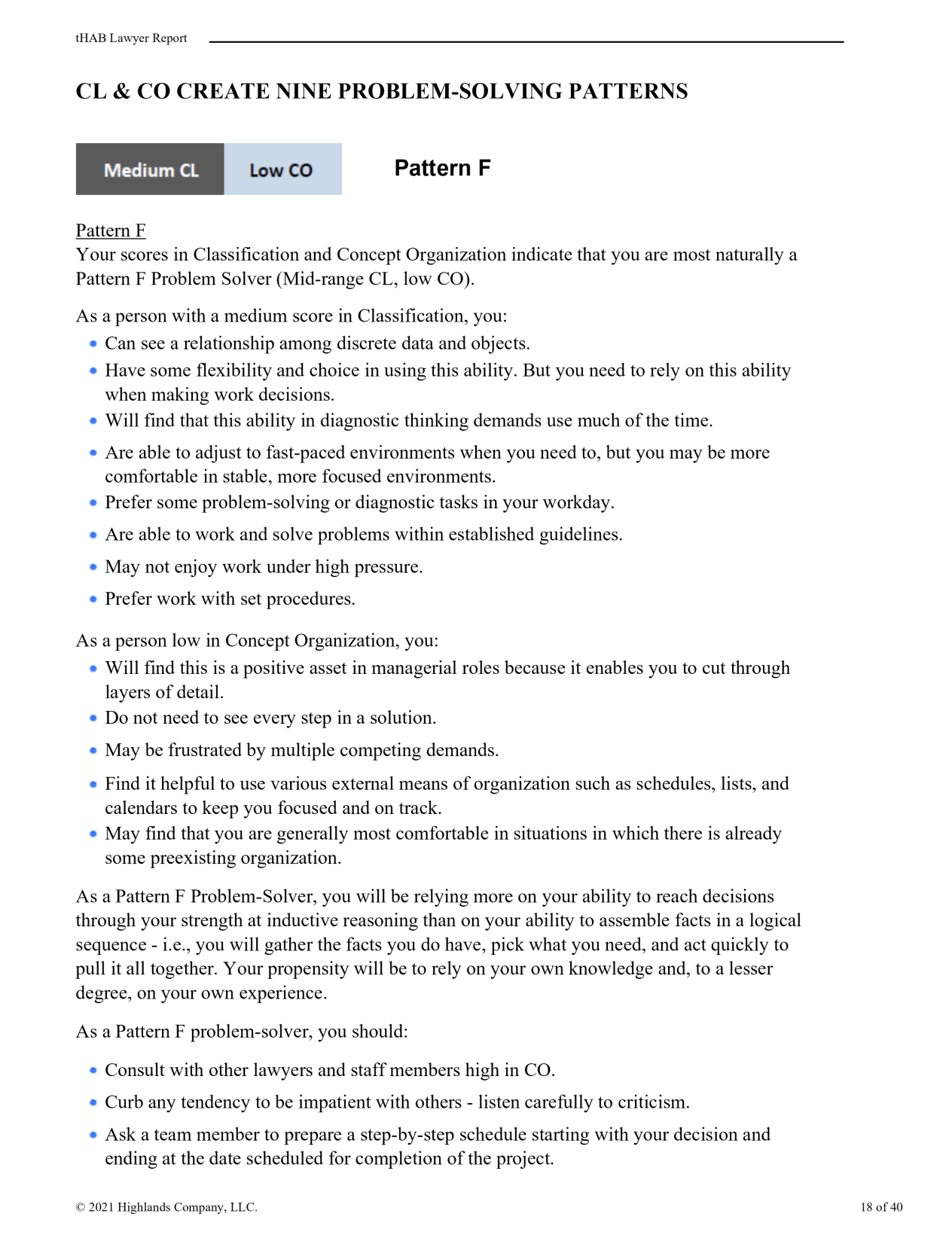
Problem-Solving Approach
Lawyers generally approach problems diagnostically, analytically, or through a combination of both methods.
A diagnostic thinker may quickly recognize connections among seemingly unrelated facts and identify a likely solution. An analytical thinker may prefer to organize information in a logical sequence before reaching a conclusion. Some attorneys identify a solution intuitively and then confirm it through careful analysis.
Recognizing these patterns can improve decision-making, collaboration, and work assignments.
Idea Generation and Evaluation
Many legal questions can be addressed through precedent, but unfamiliar challenges may require creative thinking. Some attorneys generate new ideas quickly, while others excel at evaluating, refining, and implementing those ideas.
Successful legal teams often benefit from combining these complementary abilities.
Abstract and Tangible Thinking
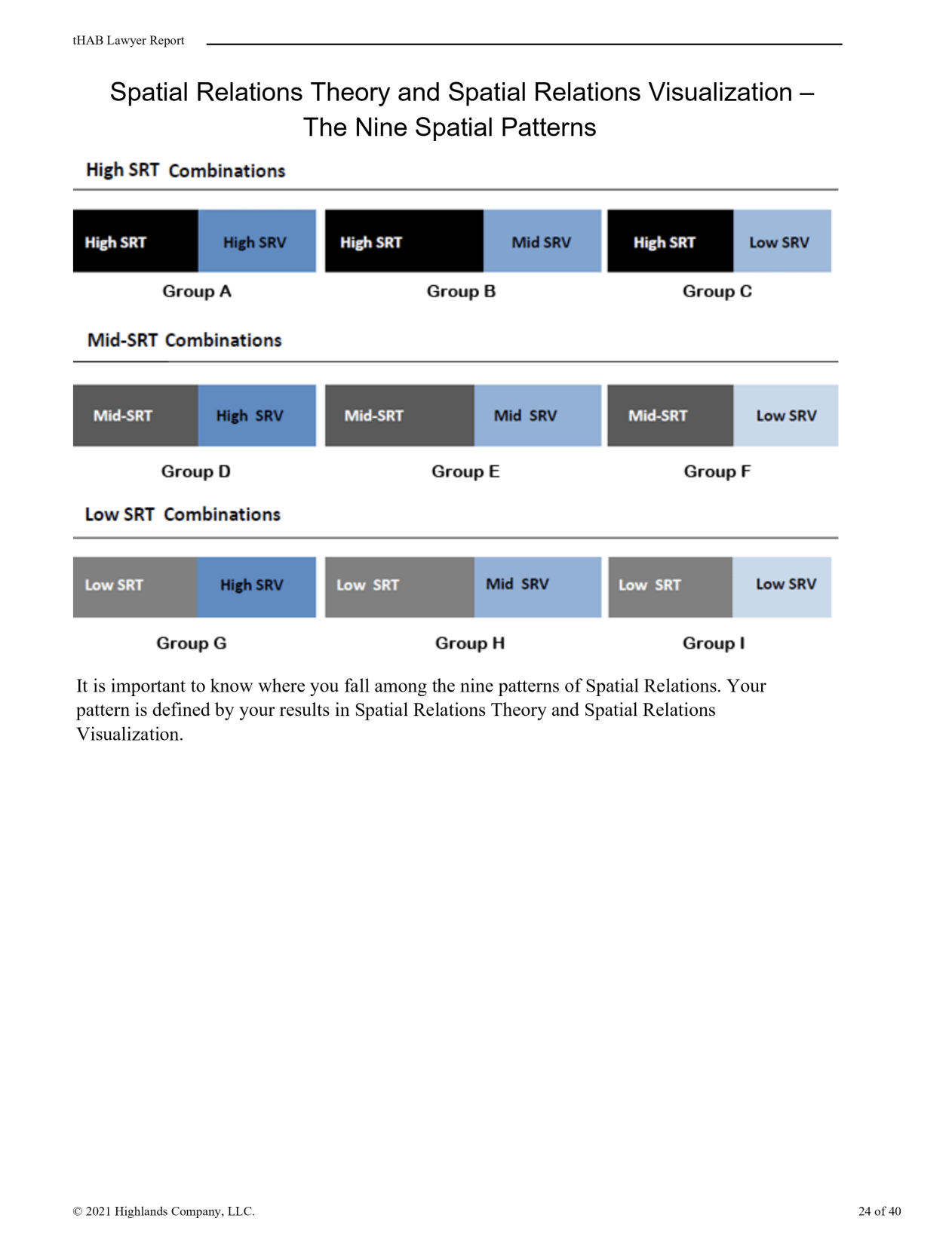
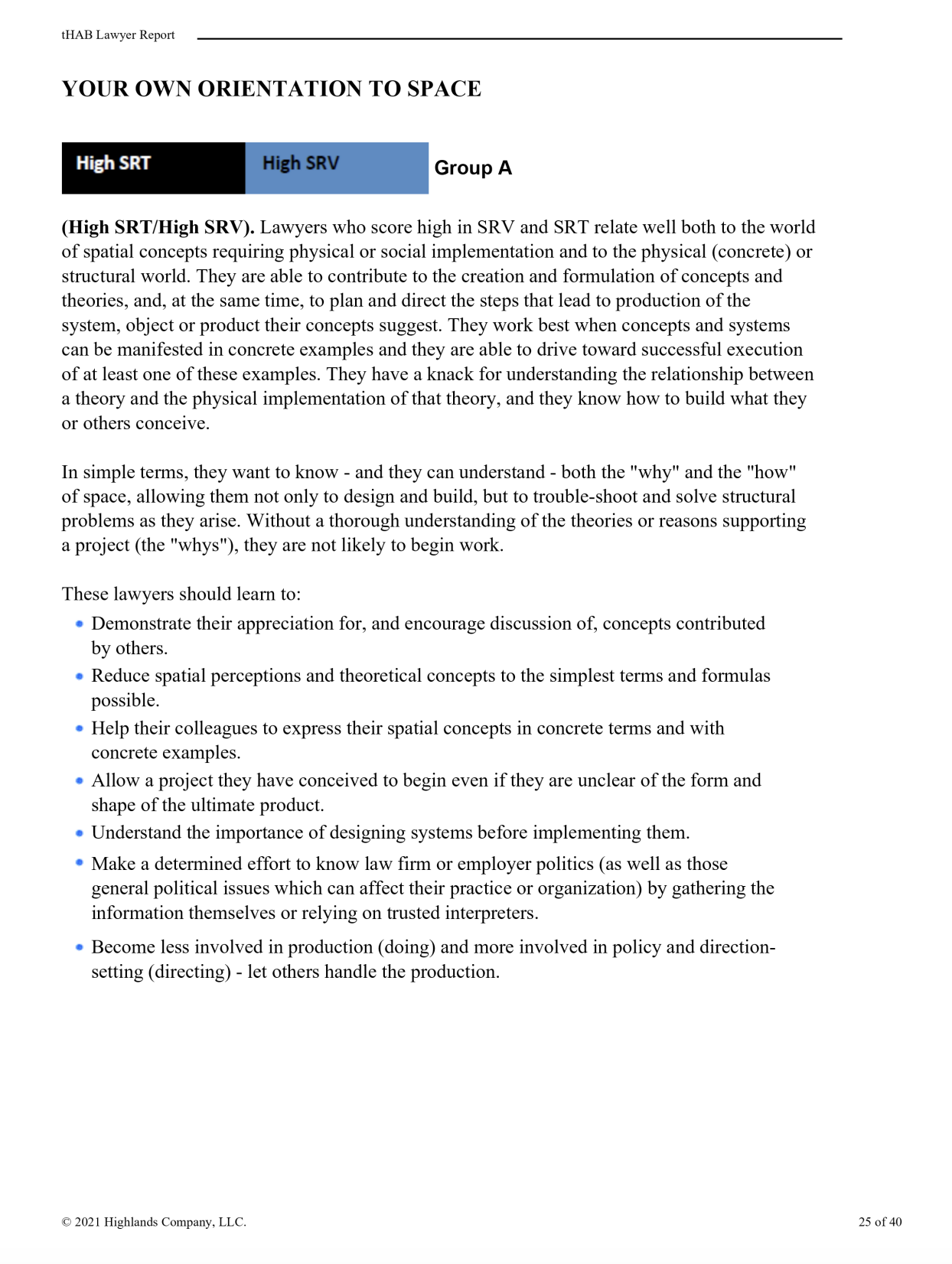
Many attorneys are comfortable working with abstract ideas, language, and complex legal concepts. Others are naturally drawn to tangible systems, physical structures, or spatial relationships.
Attorneys with strong tangible or spatial abilities may be especially interested in areas such as:
Patent and intellectual property law
Real estate law
Construction law
Project finance
Natural abilities are only one factor in choosing a legal specialty, but they can provide useful career-planning insight.
Learning Preferences
Lawyers learn and retain information through different channels. Some learn more effectively by reading, while others retain more through listening. The HAB Lawyers Report also examines additional learning abilities, including:
Design Memory
Rhythm Memory
Number Memory
Tonal Memory
Verbal Memory
The report includes a personalized learning-channel profile that can help attorneys improve professional development, continuing legal education, and preparation strategies.
Observation, Accuracy, and Auditory Abilities
The HAB also evaluates abilities such as Observation, Pitch Discrimination, and Visual Speed and Accuracy. These results provide additional insight into how an attorney notices details, processes information, and performs certain types of work.
Vocabulary and Verbal Communication
Clear writing and precise speaking are fundamental to legal practice. Although vocabulary is developed through education and experience rather than classified as a natural ability, the HAB evaluates it because strong language skills are essential for legal analysis, advocacy, negotiation, and client communication.
Build a More Fulfilling Legal Career
The HAB Lawyers Report gives law students and practicing attorneys objective insights into how they naturally work and where they may perform best. For law firms, it can support attorney development, work assignments, lateral integration, team building, succession planning, and partnership evaluation.
By aligning natural abilities with legal practice areas and professional responsibilities, attorneys can make more informed career decisions while firms can build stronger, more effective legal teams.
[Insert slideshow featuring selected pages from the HAB Lawyers Report]
Lawyers Report: Legal Career Assessment for Every Career Stage
To learn more about the value of identifying your natural abilities, explore:
Don’t Waste Your Talent

How the HAB Supports Different Legal Career Stages
-
Law students often want reassurance that earning a JD is the right path. Taking the HAB during the second year of law school can help students identify legal practice areas and work environments that align with their natural abilities.
This insight may help students make more informed career decisions before graduation and reduce the frustration that can arise when the realities of legal practice do not match their expectations.
-
Entry-Level Lawyers
Law firms invest significant time and resources in recruiting and developing new attorneys. Understanding an entry-level lawyer's natural abilities and work style can help firms:
Assign work more effectively
Improve productivity and performance
Strengthen client relationships
Support professional development
Increase attorney engagement and retention
-
When an attorney or legal team moves to a new firm, a smooth transition is essential. The HAB Lawyers Report provides objective information about work styles, communication preferences, and natural abilities, helping firms integrate lateral hires more effectively.
-
Partnership decisions often take many years. A comprehensive evaluation process should consider not only performance and experience, but also an attorney's natural abilities, leadership potential, and preferred work style.
The Highlands Ability Battery can provide valuable insight for associate development, succession planning, and partnership decisions.
Preview the Sample Lawyers Report